LDCFII

The Support Green Economy-Decoupling Hazardous Waste Generation from Economic growth in Rwanda (DHWG Project) is a five-year Project that is being implemented across Rwanda by the Rwanda Environment Management Authority (REMA) in partnership with stakeholders including the Rwanda Green Fund (FONERWA) and the Private Sector Federation (PSF) to protect human health and the environment from the adverse effects of hazardous waste. The overal goal of the project is to support the Government of Rwanda and its private and public sector in decoupling hazardous waste generation and harmful releases from economic growth by enhancing the introduction of the 4R approach (Reuse, Reduce, Recycle and Recovery) in priority industries and economic sectors, while at the same time enhancing private sector led national waste treatment capacity to ensure the sound management of wastes.

Investment

US $14,7m

Duration

5 years (2017-2022)

Status

Concluded

Project Team

Project Manager

Fidelite Ninziza

Location

RDB New Building (KG 9 Ave), 2nd floor

Email

fninziza@rema.gov.rw

Phone

+250 788474445

Environmental Impact

The LDCF-II project will contribute to reducing vulnerability to the adverse impacts of climate change, increasing adaptive capacity to respond to the impacts of climate change including variability at local, national, regional and global level, as well as promoting transfer and adoption of climate change adaptation technologies.

The EbA approaches adopted by the LDCF-II Project include conservation, restoration, maintenance of biodiversity and ecosystem processes, as well as sustainable use of natural resources to enhance people’s resilience to climate change. Implementing EbA is of particular importance for the people who are worst hit by climate change’s adverse impacts and who are largely dependent on ecosystems and their services.

In Rwanda, EbA has been implemented through Rwanda Environment Management Authority (REMA) in different wetlands, natural forests, and savanna ecosystems. The emphasis will be put on restoration activities to build people's resilience to climate change and to restore natural ecosystem functioning.
 

Sustainable Development

The LDCF-II project will improve the livelihoods of local communities, increase agricultural productivity and food security, create green jobs as well as promote gender equality and expand forest management knowledge. More than 1.7 million people are benefiting from the project, the majority of whom are women and young people. 

The project will create approximately 3,400 green jobs during the five years of implementation and provide 348 households with water tanks and 12 houses as well as 45 cows to improve the local communities’ livelihoods and increase incomes.

From a socio-economic perspective, restoration of degraded savannas and forests present several benefits to the local communities living adjacent to Ibanda-Makera natural forest by reducing burden and time spent by women and youth collecting firewood, and hence access to more time for other socio-economic activities; creating job opportunities for project beneficiaries who will undertake savannas and forests restorations activities; generating income from selling agroforestry products such as timber and fruits; and availing opportunities related to eco-tourism, educational and recreation.

IMPACT

25ha to be irrigated by solar powered irrigation and solar powered water supply for 790 cows in Kayonza District.

14/12/2021

868,000 trees to be planted in Kayonza, Kirehe, Bugesera, Ngororero, Gasabo and Musanze Districts
14/12/2021

348 households to be provided with plastic water tanks in Kayonza, Bugesera and Musanze Districts

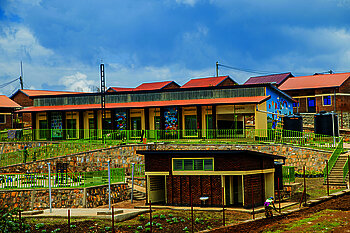
46 households to be provided with 46 houses in Gakoro Green Model Village in Musanze District
14/12/2021

3,400 green jobs to be created in Kayonza, Kirehe, Bugesera, Ngororero, Gasabo and Musanze Districts
14/12/2021

471,000 direct beneficiaries from Kayonza, Kirehe, Bugesera, Ngororero, Gasabo and Musanze Districts
14/12/2021

1.7 million beneficiaries from Kayonza, Kirehe, Bugesera, Ngororero, Gasabo and Musanze Districts
14/12/2021

Latest News

Documents

COP28 | Rwanda's Green Taxonomy Showcase

Partners